Great Barrier Reef Day Trip from Cairns: What to Expect on the Day
Check-in, the crossing, reef time, lunch, seasickness, weather and what to pack: how a full Great Barrier Reef day from Cairns runs, hour by hour.
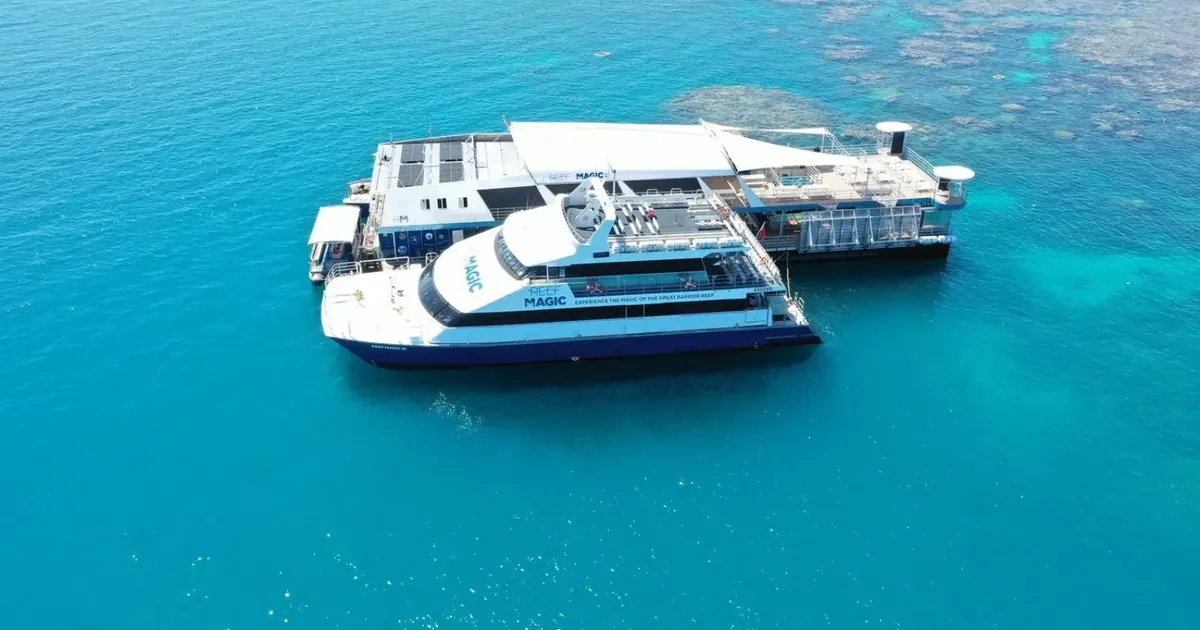
A Great Barrier Reef day trip from Cairns usually takes eight to ten hours from check-in to the walk back along the marina, and you spend about four to six of those hours at the reef on a dedicated reef boat or pontoon, or less on a day that adds an island. Most boats leave the Reef Fleet Terminal between 8 and 10:15am, spend about an hour to two hours crossing to the outer reef, and are back between about 4:00 and 5:30pm. Snorkel gear is almost always included, and many full-day trips include lunch, flotation gear and a glass-bottom boat or semi-submersible as well.
“Reef day trip” covers very different days. You might snorkel two reef sites from a small boat, spend the day on a big pontoon with an underwater observatory, or split the day between the outer reef and Green Island or Fitzroy Island. If coral and snorkelling are why you came, start with an outer reef trip. If you are travelling with children, non-swimmers or a mixed group, a pontoon is much easier. The rest of this guide follows a typical day in order.
Check Availability
Quick answer: what is a Great Barrier Reef day trip from Cairns like?
A typical full day runs roughly like this, with times varying by operator:
| Time | What usually happens |
|---|---|
| 7:00–9:45am | Check-in, depending on the operator |
| 8:00–10:15am | The boat leaves Cairns |
| About an hour to two hours later | You reach the outer reef or the first reef site |
| Late morning to mid-afternoon | Snorkelling, diving and reef activities |
| 12:00–1:30pm | Lunch, on board or on a pontoon |
| 3:00–4:00pm | The boat leaves the reef |
| About 4:00–5:30pm | Back in Cairns |
There is no universal timetable. Reef Magic leaves at 9:00am, reaches its Moore Reef pontoon at about 10:30am, gives you about five hours at the reef and is back at about 5:00pm. Sunlover’s Moore Reef day leaves at 10:15am, gives you about four hours at the pontoon and is back around 5:30pm. Ocean Freedom leaves at 8:00am and spends about six hours around Upolu Reef and its sand cay before returning in the late afternoon.
Compare how long you actually get at the reef. The total length of the tour tells you much less.
Which Cairns reef day trip should you choose?
For a fuller side-by-side of every trip type, see which Great Barrier Reef tour from Cairns is right for you.
Is a Great Barrier Reef day trip from Cairns worth it?
For most first-time visitors, yes, especially if you pick an outer reef trip and give the reef a full day instead of a quick stop.
Cairns is one of the easiest bases in Australia for the Great Barrier Reef, because boats leave from the city’s marina straight for offshore reefs, islands and permanent reef pontoons. You do not need to be a diver, and you do not necessarily need to swim. Depending on the boat, you can see the reef through:
- snorkelling
- introductory scuba diving
- certified diving
- guided snorkel tours
- glass-bottom boats
- semi-submersible boats
- underwater observatories
- helmet diving
- scenic helicopter flights, on their own or with a cruise: see our scenic flights page
The Great Barrier Reef Marine Park Authority notes that you can visit the reef all year, for anything from snorkelling and diving to sailing. Our guide to whether the Great Barrier Reef is worth visiting covers the bigger question.
The most common mistake is booking the first tour labelled “Great Barrier Reef” without checking where it goes and what you will spend the day doing.
The three main types of Cairns Great Barrier Reef day trip
1. Outer Reef boat trip
Best for confident snorkellers, underwater scenery, diving and anyone who wants reef time more than facilities.
These boats head offshore to reef systems such as Upolu, Hastings, Norman and other sites in the Cairns section of the Great Barrier Reef. Some visit more than one site during the day. Instead of tying up to a permanent platform, you usually snorkel straight from the boat or from a smaller tender.
Why choose one
You may get:
- more than one snorkelling site
- fewer passengers
- long stretches in the water
- guided snorkelling
- introductory or certified dives
- a more boat-based, expedition-style day
Ocean Freedom’s Upolu Reef day, for example, visits two areas around Upolu Reef and gives you about six hours at the reef and cay. It costs from $203 and is rated 4.8/5 from more than 1,600 reviews.
The trade-off
Facilities are usually more limited than on a pontoon. If your group includes a non-swimmer, a nervous child and a keen diver, a pontoon may keep everyone happier.
2. Outer Reef pontoon
Best for first-timers, families, non-swimmers and groups with different interests.
A pontoon is a large floating activity platform moored permanently at a reef site. The boat carries you from Cairns to the pontoon, and the pontoon is your base for the day. You can snorkel, eat lunch, sit in the shade, take a glass-bottom boat ride and go back into the water whenever you like.
Reef Magic’s Moore Reef pontoon day gives you about five hours at the reef, with snorkel gear, a buffet lunch, a glass-bottom boat and a semi-submersible included, from $228 and rated 4.7/5 from more than 180 reviews.
The Sunlover Moore Reef pontoon day gives you about four hours there, with snorkelling, an underwater observatory, a semi-submersible and a glass-bottom boat among the included activities, from $200 and rated 4.5/5 from more than 400 reviews. Our reef pontoon tours page compares the Cairns pontoons.
Why pontoons work so well
They suit groups that include:
- young children
- grandparents
- weak swimmers
- non-swimmers
- nervous snorkellers
- divers travelling with non-divers
Nobody has to spend the whole day doing the same thing.
3. Reef + island combination
Best for travellers who want variety more than maximum snorkelling time.
These trips split the day between an island and an offshore reef. Great Adventures runs a combination that leaves Cairns at 8:30am, stops at Green Island first, reaches the outer reef around 12:30pm and leaves the reef at 3:30pm. On GetYourGuide this is the Green Island and outer reef pontoon day, from $219 and rated 4.6/5 from more than 100 reviews.
Sunlover also pairs Moore Reef with Fitzroy Island and spends about two and a half hours at the reef before continuing to the island; that is the Sunlover reef and Fitzroy Island day, from $200 and rated 4.6/5 from more than 240 reviews.
These trips make sense if you want reef, beach and island scenery in one day. They make less sense if your main question is how to spend as long as possible snorkelling on the outer reef. For that, choose a dedicated reef trip.
What happens on the day?
1. You check in at Cairns Reef Fleet Terminal
Many of the big reef operators use the Cairns Reef Fleet Terminal at 1 Spence Street, beside the marina. Do not treat the departure time as your arrival time: check-in can close 15 to 45 minutes before the boat leaves.
Sunlover asks Moore Reef passengers to check in between 8:45 and 9:45am for its 10:15am departure. Reef Magic starts boarding at 8:15am, with final boarding at 8:45am for its 9:00am departure.
Practical tip
Treat the check-in deadline on your booking confirmation as the time that matters. Turn up five minutes before departure and you may watch your boat leave without you.
2. The boat journey takes about an hour to two hours
For outer reef trips, allow about an hour to two hours each way, depending on the reef and the boat. Ocean Freedom takes just over an hour to reach Upolu Reef, while Reef Magic and Sunlover quote about 90 minutes to Moore Reef. Our guide to how far the Great Barrier Reef is from Cairns lists the crossing for each reef.
The crew use the crossing for:
- safety briefings
- snorkelling instructions
- dive paperwork
- introductory dive briefings
- marine talks
- fitting equipment
If you have booked a dive, doing the paperwork on the way out means you can start sooner once you reach the reef.
What is the boat ride like?
On calm days the crossing is uneventful, and on windy days it is much less pleasant.
The open water between Cairns and the outer reef can get choppy, and wind and swell matter more to how comfortable the boat feels than whether the sky is sunny. Reef Magic advises checking the wind when you choose which day to travel.
If you get motion sickness, do not wait for your first hour at sea to find out how badly. Take your usual seasickness medication before departure, following the directions on the pack or the advice of a pharmacist or doctor. Reef Magic recommends taking precautions before the boat leaves, and Sunlover also advises taking medication before symptoms start.
Other things that help:
- eat a light breakfast
- sit outside where you can see the horizon
- keep phone use short
- stay near the middle of the boat instead of the bow
Do not cancel because Cairns itself looks grey. Conditions 40 to 50 km offshore can be very different from the weather in town.
What happens when you reach the reef?
That depends on your tour. On a pontoon trip, the boat ties up alongside the platform and you spend the next few hours using it as your base. On a smaller reef boat, the crew moor at a snorkel or dive site and you get in from the boat or its stern platform.
Either way, you usually get a snorkel and safety briefing before you go in. After that, you decide how much of the day to spend underwater.
How much time do you actually get at the Great Barrier Reef?
This is one of the most useful things to compare before you book. Current examples show how much the itineraries vary:
| Example trip | Approx. reef time |
|---|---|
| Sunlover Moore Reef | About 4 hours |
| Reef Magic Moore Reef | About 5 hours |
| Ocean Freedom Upolu Reef and cay | About 6 hours |
| Sunlover reef and Fitzroy Island | About 2.5 hours at the outer reef |
| Great Adventures Green Island and outer reef | About 3 hours at the outer reef |
Schedules and conditions change, so check the itinerary for your date before you book.
Our rule of thumb
If snorkelling is the reason you are going, put reef time ahead of the length of the inclusions list. Five hours at a good reef site with a mask and snorkel can give you more than a packed itinerary that leaves only a short swim between activities.
Is snorkelling included?
On most mainstream full-day reef cruises from Cairns, basic snorkel gear is included. That usually means:
- mask
- snorkel
- fins
- a flotation device if you need one
Many operators also lend Lycra or wetsuit-style protective suits. Reef Magic, for example, includes snorkel gear, flotation devices and the use of a wetsuit or Lycra suit.
Always check your own booking, though. “Reef cruise” does not automatically mean every water activity is included.
Should you book a guided snorkel?
If you are reasonably confident in the water, you can usually snorkel on your own within the marked area. A guided snorkel helps for a different reason: the guide knows what you are looking at. Without one, a patch of coral can look like a colourful underwater garden and nothing more.
A marine biologist or naturalist can point out:
- giant clams
- anemonefish
- cleaner stations
- coral species
- reef sharks
- rays
- turtles
- small creatures you would otherwise swim straight past
A guided snorkel is especially useful on your first reef visit. Our Great Barrier Reef snorkelling guide covers technique, and the best places to snorkel the reef from Cairns compares the sites.
Can beginners snorkel on a Great Barrier Reef day trip?
Yes. You do not need any snorkelling experience for most Cairns reef tours. The crew give instructions before you get in, and flotation gear is widely available.
If you are nervous, choose a trip with:
- a large snorkelling platform
- lifeguard supervision
- flotation vests or noodles
- sheltered snorkelling areas
- optional guided snorkelling
Pontoon tours are particularly easy because you step into the water from purpose-built stairs or platforms instead of jumping off a boat. Reef Magic describes its platform as built for easy water access and has flotation gear in adult and child sizes.
What if you can’t swim?
You can still see the Great Barrier Reef, and this is where pontoon tours have a big advantage. Depending on the platform, you can see the reef through:
- glass-bottom boats
- semi-submersibles
- underwater observatories
- helmet-diving experiences, such as the Green Island and Seawalker helmet dive day, from $203 and rated 4.3/5 from 67 reviews
Sunlover’s Moore Reef day includes a glass-bottom boat, a semi-submersible and an underwater observatory, so you can see coral and fish without getting wet. A mixed group does not have to choose between “everyone snorkels” and “we don’t go”. Our guide to the Great Barrier Reef for non-swimmers goes into more detail.
Can you scuba dive on a Cairns reef day trip?
Often, yes. There are two kinds of diving on a day trip.
Introductory diving
For people who are not certified divers. You get instruction and dive under close professional supervision.
Certified diving
For travellers who already hold a recognised dive certification. Some boats offer one or more dives during the day.
If diving is one of your main reasons for coming, check:
- which reef sites the tour visits
- how many dives are available
- the maximum group size
- whether equipment is included
- medical requirements
- the minimum age
- the time you need between diving and any flight
Do not book a general reef cruise and assume it gives you the diving day you want. Our scuba diving guide compares the dive boats, and the Divers Den AquaQuest reef day visits two of its moorings at Norman, Saxon and Hastings reefs, from $179 and rated 4.6/5 from more than 1,600 reviews.
Is lunch included?
Often, but not always. The large full-day outer reef cruises usually include lunch: Reef Magic and Sunlover both serve a buffet lunch on their Moore Reef days. Smaller boats may serve a buffet or a cold lunch on board, and island-only tickets or shorter trips may handle meals differently.
Check for:
- lunch
- morning tea
- afternoon tea
- tea and coffee
- dietary requirements
- drinks from the bar
If you have an allergy or a special diet, tell the operator before the day, not when lunch is served 45 km offshore.
What should you bring?
Not much.
Essential
- swimwear
- towel
- hat
- sunglasses
- sunscreen
- reusable water bottle
- booking confirmation
- payment card
Very useful
- dry clothes for the trip back
- a lightweight long-sleeved top
- seasickness medication if you need it
- a waterproof phone pouch
- a hair tie
- a small dry bag
Great Adventures recommends swimwear, a towel, a hat and sunscreen for its reef trips.
Wear your swimsuit under your clothes
This small bit of planning saves a surprising amount of time. When the boat reaches the reef, everyone wants the changing rooms at once, so arrive ready to swim.
Do you need to bring snorkelling gear?
Usually not; standard gear comes with the big reef cruises. Bring your own if:
- you need a prescription mask
- you are particular about fit
- you already own gear you prefer
The supplied gear is made for general visitors, not for freedivers or underwater photographers.
Can you take an underwater camera?
Yes, and the Great Barrier Reef is one of the few places where a waterproof camera earns its space in the bag. A GoPro or other waterproof camera works well while snorkelling, because much of what you see is in shallow water with good natural light.
A few tips:
- attach a wrist strap
- use a floating grip
- do not chase marine animals for photos
- do not stand on coral
- keep an eye on where you are swimming
Great Adventures does not allow drones on its trips, and hires out underwater cameras in limited numbers.
Will you see turtles?
Possibly, but never book a reef trip because a tour page shows one particular animal. Depending on the site and your luck, you could see:
- butterflyfish
- parrotfish
- angelfish
- anemonefish
- giant clams
- sea cucumbers
- rays
- turtles
- reef sharks
- Maori wrasse
- schools of tropical fish
Whales also pass through the wider region in season. The Great Barrier Reef is a wild ecosystem, not an aquarium, and no reputable operator can guarantee a turtle, a shark or any other particular animal.
What does the coral actually look like?
Not every metre of reef looks like a saturated tourism poster. A healthy reef can include:
- branching corals
- table corals
- boulder-like massive corals
- soft corals
- sandy patches
- darker sections
- pale sections
- coral rubble
- channels and reef edges
Some coral colonies are brightly coloured, but much living coral is naturally tan, brown, cream or muted green. The structure, the scale, the fish and the variety impress far more than neon colour.
Will the water be clear?
Often, but visibility changes. It is affected by:
- wind
- swell
- tides
- plankton
- rainfall
- currents
- recent weather
One reason Cairns operators use different reefs and moorings is to work with the conditions on the day, instead of promising the same underwater scene every morning. Do not judge tomorrow’s visibility from today’s weather app.
What happens if it rains?
Usually the trip still runs. Rain on its own rarely matters; wind, swell and marine safety do. Reef Magic says its tours go ahead in rain and that conditions offshore can differ from those in Cairns. Sunlover also says rain or cloud does not automatically cancel a trip, and that sea conditions, safety and operational factors decide whether it runs.
Once you are snorkelling, rain hardly matters. You are already wet.
What happens if the weather is too rough?
The operator may:
- switch to a different reef site
- change some activities
- postpone the trip
- cancel the trip
Cancellation policies differ. Reef Magic says that if it cancels a tour for weather or unforeseen circumstances, you can be offered another date or a refund. Sunlover says that when it cancels before departure, it may offer another date or itinerary or a refund.
Deciding not to go yourself because you dislike the forecast is different from the operator cancelling. Check the booking conditions before you pay, especially if your Cairns plans have little room to move. Most trips booked on GetYourGuide can be cancelled for a full refund up to 24 hours ahead; the listing for your trip shows its exact terms.
Should you book the first or last day of your Cairns stay?
Ideally neither. If you can, put the reef trip in the middle of your stay. That leaves room if:
- sea conditions are poor
- the operator cancels
- you are unwell
- your flight into Cairns is delayed
Booking the reef on your last full day leaves no second chance, which matters most if the reef is the main reason for your Cairns trip.
Which weather matters most for a reef trip?
Most people look at the sunny, rainy or cloudy icon. For the boat ride, wind and sea conditions matter more. A cloudy day with little wind can be much more pleasant than a sunny but windy one, and Reef Magic recommends choosing a day with less wind where you can. Our best time to visit the Great Barrier Reef guide goes through the months.
Is it better to visit the reef in the morning?
Not necessarily. On a full-day trip you follow the operator’s schedule anyway, and conditions change through the day with:
- tide
- sun angle
- wind
- current
- cloud cover
There is no single perfect time of day for viewing the reef. The quality of the site and the conditions on the day matter much more.
How much does a Great Barrier Reef day trip from Cairns cost?
For a full outer reef day, expect to pay a few hundred Australian dollars per adult, with diving, helicopter flights and premium extras on top. As of October 2026, the operators’ own adult fares include:
- Sunlover Moore Reef: from about A$317
- Reef Magic Moore Reef: from about A$325
- Great Adventures outer reef: about A$312, with a fuel surcharge applying to its outer reef cruises
On GetYourGuide the same days start at about $200 for Sunlover, $228 for Reef Magic and $199 for Great Adventures, in US dollars. Prices change with the date, season, promotions and package, so treat these as a current benchmark, not a fixed price.
Don’t compare only the headline price
Look at:
- actual reef time
- the number of reef sites
- passenger numbers
- lunch
- snorkel gear
- wetsuit or Lycra hire
- a guided snorkel
- a glass-bottom boat
- a semi-submersible
- environmental fees
- a fuel surcharge
- hotel transfers
A ticket that is A$20 cheaper is not cheaper if the activities you want all cost extra. Our best Great Barrier Reef tours from Cairns page compares what each trip includes.
How to choose the right Great Barrier Reef day trip
Instead of asking which Cairns reef tour is best, ask yourself these questions.
Do I mainly want to snorkel?
Choose a dedicated outer reef trip with plenty of time in the water.
Am I a certified diver?
Choose by dive sites and the number of dives, not by pontoon facilities.
Am I nervous in the water?
A pontoon with easy access, flotation gear and lifeguards will probably feel easier.
Do I have children?
A pontoon offers more variety and somewhere comfortable to rest between swims.
Does someone in my group not swim?
Prioritise glass-bottom boats, semi-submersibles and an underwater observatory.
Do I want beach time too?
Look at Green Island or Fitzroy Island, or a reef and island combination.
Do I want maximum reef time?
Avoid splitting the day between too many places. A long list of stops looks good on a booking page, but every transfer is time you are not swimming over coral.
Pontoon vs boat: which is better?
Neither is better for everyone.
| Choose a pontoon if… | Choose a reef boat if… |
|---|---|
| You’re a first-timer | Snorkelling is your priority |
| You’re travelling with children | You want several reef sites |
| Someone can’t swim | You prefer smaller groups |
| You want glass-bottom boats | You’re comfortable in open water |
| You want lots of facilities | You want a more active day |
| Your group has mixed abilities | Diving is a major priority |
They are not interchangeable: each gives you a different day.
Outer Reef vs Green Island for a day trip
If you have one day and your main goal is coral and snorkelling, look at the outer reef first.
Choose Green Island if you want:
- a beach
- rainforest
- a walk around an island
- time on land at your own pace
- a shorter crossing
Choose the outer reef if you want:
- underwater scenery
- longer reef sessions
- snorkelling
- scuba diving
- a day focused on the reef
If you are still torn, some tours combine an island and the outer reef in one day. Green Island is 27 km from Cairns and about 45 minutes by fast catamaran; the Great Adventures Green Island cruise starts at $79 and is rated 4.4/5 from more than 1,900 reviews. Our outer reef vs Green Island comparison and is Green Island worth visiting cover the choice in full.
How far is the Great Barrier Reef from Cairns?
There is no single distance, because the Great Barrier Reef is not one reef. Cairns boats go to different islands, cays and offshore reef systems. For scale, the Reef Magic and Sunlover pontoons at Moore Reef sit about 45 to 47 km offshore. That is why an outer reef trip takes a full day and is more than a quick boat ride from the beach. Our outer Great Barrier Reef guide explains what the extra distance gets you.
Can you do the Great Barrier Reef in half a day?
Some half-day trips and cruise-and-flight combinations exist, but for a first visit we would choose a full day unless your schedule rules it out. The travel time explains why: at about an hour to two hours each way, a short trip spends a large share of the day getting there and back.
A full day gives you time to:
- settle into snorkelling
- take a break
- eat lunch
- snorkel again
- try another activity
The second swim is often better than the first, because you have stopped fighting your mask and started looking around. If a half day is all you have, the Reef Adventures half-day snorkelling trip gives you about an hour and a half of guided snorkelling, from $126 and rated 4.7/5 from more than 1,900 reviews; our half-day reef tours page lists the others.
Is a Great Barrier Reef day trip good for children?
It can be excellent. Pontoon trips work especially well for families, because children do not have to spend five hours swimming. Depending on the operator and age limits, families may have:
- snorkelling
- flotation devices
- glass-bottom boats
- semi-submersibles
- underwater observatories
- enclosed swimming areas
- educational talks
Check minimum ages carefully for scuba, helmet diving and other optional activities.
Should you book in advance?
Yes, especially if:
- you are visiting during school holidays
- you have only one free day for the reef
- you want an introductory dive
- you want a helicopter combination
- you are travelling as a family
- you want a small-group boat
Booking ahead also lets you compare the actual itineraries instead of taking whatever still has seats when you arrive. If you are in Cairns for several days and want room for the weather, keep the rest of your plans flexible around the reef day.
Great Barrier Reef day trip packing checklist
Before you leave your hotel:
- swimsuit already on
- towel
- sunscreen
- hat
- sunglasses
- dry clothes
- seasickness medication if you need it
- booking confirmation
- payment card
- underwater camera or GoPro if you use one
- reusable water bottle
Leave the big backpack at the hotel. You need far less on a reef boat than you think.
Common mistakes to avoid
Booking based only on price
Compare reef time, not just the ticket price.
Assuming every tour goes to the same reef
They don’t. Different operators visit different reefs, cays, islands and pontoons.
Ignoring seasickness
If you are prone to it, take precautions before departure.
Choosing an island when you really want coral
An island day and an outer reef day are not the same.
Trying to do every activity
You do not need to snorkel, dive, ride three boats, attend every talk and photograph lunch. Leave enough time just to be in the water.
Checking only the rain forecast
Wind and swell often matter more for comfort.
Scheduling the trip just before you leave Cairns
Keep a backup day where you can.
Is one day enough for the Great Barrier Reef?
For most visitors, yes. A well-chosen full day gives you enough time to see why the reef is special without giving up several days of your holiday. One day cannot show you the whole Great Barrier Reef: it is an enormous ecosystem with thousands of individual reefs and hundreds of islands. Think of a Cairns day trip as one small, carefully chosen window into it.
If you love the first day, that is when a second day, a dive trip or a liveaboard starts to make sense. The two-day dive and snorkel liveaboard starts at $470 and is rated 4.6/5 from more than 100 reviews.
Our recommendation for first-time visitors
If this is your only Great Barrier Reef day, choose by your strongest priority.
- For the most reef-focused day: a dedicated outer reef snorkelling boat with plenty of reef time, such as Ocean Freedom.
- For families or mixed abilities: an outer reef pontoon, such as Reef Magic or Sunlover.
- For non-swimmers: a pontoon with a glass-bottom boat, a semi-submersible and an underwater observatory.
- For beach and reef: Green Island, Fitzroy Island or a Green Island and outer reef combination.
- For divers: ignore the longest list of general activities and compare the actual dive programme.
Above all, do not pick the tour that keeps you away from Cairns longest. Pick the one that gives you the most time doing what you came to the Great Barrier Reef to do.
Great Barrier Reef day trip from Cairns FAQ
How long is a Great Barrier Reef day trip from Cairns?
Most full-day trips take about eight to ten hours from check-in to return, although itineraries vary. Cairns reef boats are usually back between about 4:00 and 5:30pm.
How long does the boat take from Cairns to the Great Barrier Reef?
For the outer reef, about an hour to two hours each way. Ocean Freedom takes just over an hour to Upolu Reef, and the Moore Reef pontoon boats take about 90 minutes.
How much time do you spend at the reef?
About four to six hours on a dedicated reef boat or pontoon. Days that add Green Island or Fitzroy Island give you less at the outer reef: about three hours on the Great Adventures combination and about two and a half on Sunlover’s Fitzroy day.
Where do reef tours leave from in Cairns?
Many of the big operators check in at the Cairns Reef Fleet Terminal, 1 Spence Street, beside the marina.
Is snorkelling included?
Usually, on full-day reef cruises. Masks, snorkels and fins are standard, and many operators also provide flotation gear and protective suits.
Is lunch included?
Often on full-day outer reef tours, but check your own package.
Can you visit the Great Barrier Reef without swimming?
Yes. Pontoon tours may include glass-bottom boats, semi-submersibles and underwater observatories, so you can see the reef and stay dry.
Is Green Island or the Outer Reef better?
For snorkelling and coral, look at the outer reef first. For a beach, rainforest and a mix of land and water, Green Island may suit you better.
What if it rains?
Tours usually still run. Wind, swell and safety conditions matter more than rain.
Can reef tours be cancelled?
Yes, although operators describe weather cancellations as uncommon. If the sea becomes unsafe, tours may be changed or cancelled, and refund and rebooking policies vary by operator.
Is a pontoon better than a normal reef boat?
A pontoon is usually easier for families, non-swimmers and mixed groups. A smaller reef boat usually suits keen snorkellers and divers better.
Ready to pick a date? Check availability on Ocean Freedom’s Upolu Reef day, or compare the best Great Barrier Reef tours from Cairns.
Two Outer Reef Sites, One Day on a Catamaran
Snorkelling gear and a guided snorkel tour, a chef-prepared lunch, morning and afternoon tea, and a marine life talk on board. Rated by more than 3,800 guests, with free cancellation.
Check Availability & Book