Snorkelling or Scuba Diving on the Great Barrier Reef from Cairns?
Snorkelling or scuba on the reef from Cairns? Coral views, cost, age and medical rules, depth, flying afterwards and which suits couples, families and nervous swimmers.
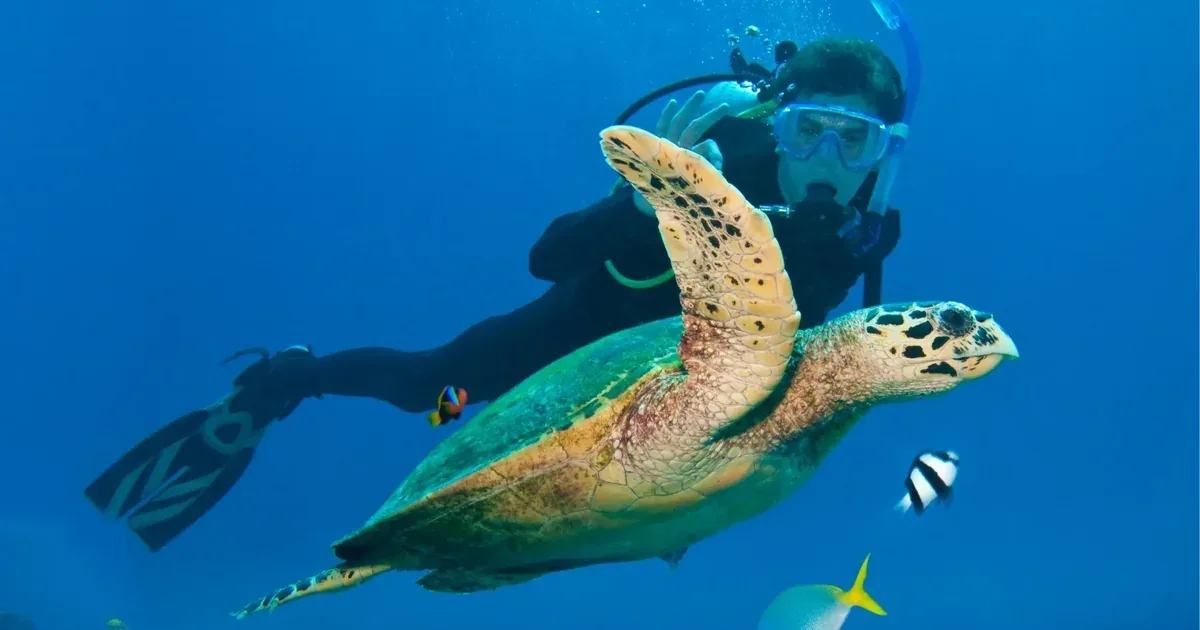
Snorkel if you mainly want to see the coral: on a first Great Barrier Reef trip from Cairns it is the easiest, cheapest way to spend hours over shallow reef, and it suits families and mixed groups. Dive if being underwater is part of the dream: scuba puts you beside reef walls and bommies at eye level for 30 to 50 minutes at a time.
If you can’t decide, book an outer reef boat that sells both. Many Cairns boats let you snorkel all day and add an introductory dive on board, as long as you are 12 or older and pass the medical questions. The Great Barrier Reef Cruise by Premium Catamaran from Cairns, $193, 4.8/5 from 3,950+ reviews works that way, with intro and certified dives sold as extras.
Check Availability
The quick answer
You do not need to scuba dive to see beautiful coral and marine life on the Great Barrier Reef. Some of the reef’s most colourful coral grows in shallow, sunlit water, which is where snorkellers spend their time, and Cairns operators point to their reef tops as some of their best snorkelling.
Choose snorkelling if you want the easiest and least complicated way to explore the reef. Choose scuba diving if the feeling of being underwater is part of the attraction: you go down beneath the surface, swim alongside the reef instead of looking down on it, and spend longer over a single fish, coral head or ledge.
For many first-time visitors the best answer is both. Snorkel for most of the day and add one introductory dive.
Snorkelling vs scuba diving at a glance
| Snorkelling | Scuba diving | |
|---|---|---|
| Certification required | No | No for an introductory dive; yes for certified diving |
| Where you are | At the surface | Underwater |
| Coral views | Excellent, especially over shallow reef tops | Excellent |
| Suits beginners | Yes | Yes, with an instructor |
| Medical screening | Fewer restrictions, though health and fitness still matter | Medical declaration required for an introductory dive |
| Minimum age | Set by each tour | Usually 12 for an introductory dive from Cairns |
| Cost | Lower | Higher |
| Equipment | Mask, snorkel, fins; often a flotation vest and Lycra suit | Mask, fins, regulator, BCD, tank, weights, wetsuit |
| Freedom to explore | High, within the marked area | More structured, following an instructor or dive plan |
| Time in the water | As long as the conditions and the day’s schedule allow | Individual dives of about 30 to 50 minutes |
| Families | Excellent | Better for older children and teens who meet the rules |
| Non-swimmers | Usually better served by a pontoon’s dry viewing | No |
| What it feels like | Floating above a living coral garden | Being inside the underwater landscape |
| Flying afterwards | No restriction | Wait at least 12 hours after one dive |
Is scuba diving better than snorkelling on the Great Barrier Reef?
Not necessarily, and it is worth knowing that before you book.
Plenty of the interesting coral on the Great Barrier Reef is not far below the surface. Coral needs sunlight, and many reef tops sit shallow enough for a snorkeller to see coral, giant clams and tropical fish clearly. The reef is not a deep diving destination either: Silverswift, for example, says its dives are about 12 to 18 metres deep.
Scuba does not give you better coral. It gives you a different way of looking at it. From the surface you look down across a broad reef garden. Underwater, you look sideways into the reef, swim beside coral walls and bommies, and watch fish move at your own eye level. That difference can be extraordinary, and snorkelling is still a first-rate way to see the reef.
Why choose snorkelling?
For a one-day trip from Cairns, snorkelling is the easiest place to start. You step off the boat, practise for a few minutes and start exploring without spending a large part of the day learning new equipment.
Snorkelling is best if you:
- have never visited a coral reef before
- want the most freedom in the water
- would like to avoid scuba medical requirements
- are travelling with children
- want to spend less
- feel uncomfortable about breathing underwater
- mainly want to see colourful coral and tropical fish
- are travelling in a mixed group
- are flying soon after your reef trip
- want plenty of underwater photos without managing scuba equipment
For a snorkel-only day, the Great Barrier Reef Half-Day Snorkelling Tour from Cairns, $126, 4.7/5 from 2,060+ reviews covers two outer reef sites in a morning or afternoon, and the Passions of Paradise catamaran gives you a full day.
What can you actually see while snorkelling?
Sightings on the reefs visited from Cairns can include:
- hard and soft corals
- parrotfish
- butterflyfish
- angelfish
- damselfish
- anemonefish
- giant clams
- sea cucumbers
- sea stars
- green turtles
- rays
- reef sharks
- wrasse, including the large Maori wrasse
No sighting is guaranteed. What you see depends far more on the reef site, the weather, visibility and luck than on whether you wear a snorkel or a regulator. A turtle can swim right under a snorkeller while a diver nearby misses it for a whole dive.
Is snorkelling good enough for the Great Barrier Reef?
Yes. Snorkelling is not the cheap version of the reef, so don’t book a dive out of worry that you will miss out.
On a good outer reef day, a strong swimmer over shallow coral can cover a large area of reef. Snorkellers also get one advantage divers tend to underestimate: perspective. From the surface you see bigger sections of reef at once, and coral gardens, channels, bommies and sand patches form patterns that are harder to read from a few metres away.
What are the disadvantages of snorkelling?
There are a few.
You remain at the surface
You look down at the reef instead of moving through it. Where the reef slopes away sharply, divers can follow it down while snorkellers stay above.
Waves can make it harder
Even a light chop can splash into your snorkel or make photos harder to take. Once a diver is a metre or two below the surface, those small waves barely matter.
It can be surprisingly tiring
Snorkelling looks effortless, but Queensland’s workplace safety regulator warns that it can be strenuous, especially for people with medical conditions affected by exertion or water. Cairns operators also say that reasonable swimming ability and fitness help. If you are nervous in open water, tell the crew instead of hiding it.
Why choose scuba diving?
Scuba gives you something snorkelling cannot: the feeling of entering the underwater world. Instead of floating above the reef, you go down into it. Fish pass beside you, reef walls rise next to you, and you can stop at a coral bommie and watch small fish cleaning, feeding and defending their patch at eye level. For some people that is the highlight of their whole Queensland trip.
Scuba is best if you:
- have always wanted to try diving
- are confident in the water
- want the most immersive way to see the reef
- enjoy adventure activities
- are already a certified diver
- want to explore reef walls, ledges and deeper structures
- would like to watch one area slowly instead of covering a lot of surface
- are comfortable with masks and breathing equipment
- have enough time before your next flight
I’ve never dived before. Can I scuba dive on the Great Barrier Reef?
Yes, as long as you meet the operator’s age and medical requirements. You do not need a certificate for an introductory dive, also called a resort dive or non-certified dive. On Cairns reef trips you get a briefing and equipment training before you go in, and an instructor stays close the whole time.
Divers Den runs introductory dives for people with no scuba experience, with skills practice before you descend, to a maximum of about 12 metres; you can book its day on GetYourGuide as the Premium Snorkelling and Diving Reef Day Trip from Cairns, $179, 4.6/5 from 1,620+ reviews. Other Cairns boats sell intro dives alongside an ordinary snorkelling day. On the Silverswift Three Reef Sites in One Day from Cairns, $216, 4.7/5 from 690+ reviews, introductory divers can do up to two dives and certified divers up to three.
How old do you have to be to scuba dive from Cairns?
Twelve is the usual minimum age for an introductory dive. Divers Den, Silverswift and Sunlover all set 12 as the minimum, and divers under 18 need a parent’s or guardian’s consent.
Certification courses can have different rules, so don’t assume the introductory-dive minimum applies to every course.
Do you need a medical certificate to try scuba diving?
Not automatically, but you do fill in a medical declaration. Under Queensland rules, anyone doing a non-certified or entry-level dive completes the declaration, and the operator reviews it and decides whether it is reasonable for you to dive.
Conditions that may need a doctor’s check, or rule out a dive, can include certain:
- heart conditions
- respiratory conditions
- asthma-related issues
- epilepsy or conditions that cause loss of consciousness
- diabetes
- ear or sinus problems
- medications
Queensland’s workplace safety guidance singles out heart conditions, respiratory conditions and anything that can cause loss of consciousness. Check this before you are standing on the boat: if you have a medical condition or take regular medication, read the operator’s questionnaire before you book the dive.
Is introductory diving scary?
Many beginners find breathing underwater for the first time stranger than the depth. Your brain has spent your whole life telling you not to breathe in with your face underwater, and scuba asks you to do exactly that through a regulator.
The first minute can feel unnatural. Then, for many people, it changes: the regulator keeps giving you air, your breathing slows and you start looking around instead of thinking about the equipment.
Not everyone enjoys that sensation, and there is no prize for forcing yourself through it. If breathing underwater fills you with dread instead of curiosity, snorkelling still gives you a superb reef day.
Do you need to be a strong swimmer to scuba dive?
You should be comfortable in the water. Introductory divers are closely supervised, but scuba is still a physical water activity: you need to follow instructions, breathe normally, equalise the pressure in your ears and communicate with your instructor. If you cannot swim confidently, talk to the operator before you book.
For someone who cannot swim at all, a pontoon trip is usually the better start, with dry ways to see the reef such as:
- glass-bottom boats
- semi-submersibles
- underwater observatories
An introductory dive is not a way round being unable to swim. Our guide to the reef for non-swimmers covers those trips.
How deep will you dive?
Introductory diving from Cairns is shallow recreational diving, not deep-water exploration. Divers Den takes introductory divers to a maximum of about 12 metres (40 feet). Silverswift says its dives are about 12 to 18 metres deep, depending on the site. Certified divers may get more leeway, depending on their qualification, experience, the operator and the site.
What does scuba let you see that snorkelling doesn’t?
Reef walls and slopes
Where a reef drops away from the surface, a diver can move down beside it.
Undersides and ledges
Marine life often shelters under coral shelves and inside reef structures that are hard to see from above.
Fish at eye level
It sounds minor until you try it. A school of fish passing around you instead of below you makes the reef feel three-dimensional.
Longer close-up observations
A snorkeller keeps switching between swimming, lifting their head, clearing the snorkel and checking where they are. A comfortable diver can settle into a slower rhythm and watch one spot.
Different reef scenery
Depending on the site, dives can take in bommies, walls, pinnacles, ledges, swim-throughs or drift sections.
Will scuba divers see more marine life?
Not necessarily. Divers may find species or behaviour further down the reef, but animals don’t sort themselves by your booking. Many of the reef’s best-known animals spend plenty of time at snorkelling depth. A snorkeller may see:
- turtles
- reef sharks
- rays
- schools of colourful reef fish
- giant clams
- anemonefish
without going below the surface. A good reef site, on a boat that can choose its sites to suit the day’s conditions, can matter more than going deeper.
Which has better visibility?
Usually neither. Snorkellers and divers on the same outer reef boat get the same water. Visibility changes with:
- wind
- tides
- currents
- rainfall
- plankton
- local reef conditions
- recent weather
Divers sometimes get a cleaner view below a choppy surface, while snorkellers get strong sunlight lighting up the reef top. Don’t choose scuba because you expect clearer water.
Which is better for underwater photography?
It depends on your camera and your experience.
Snorkelling is easier for casual photos
An action camera is easy to carry while snorkelling. You can photograph:
- coral gardens
- turtles
- giant clams
- shallow-water fish
- your travel companions
without managing dive gear at the same time.
Scuba offers better close-up angles
Divers can photograph a subject from the side instead of always pointing down. But an introductory dive is the wrong time to concentrate on a camera: your attention goes on breathing, buoyancy, hand signals and your instructor. Some Cairns operators do not let introductory divers take a camera on their first dive.
Which is cheaper: snorkelling or scuba diving?
Snorkelling. Scuba needs extra equipment, tanks and instructors, so it costs more.
Booked direct, Divers Den lists its AquaQuest outer reef snorkelling day from A$255. Its introductory diving day with one dive is A$275 on a special valid until 18 December 2026; the standard fare starts from A$365, and two introductory dives cost A$425. Silverswift charges A$308 for its standard snorkelling day, plus a A$10 fuel surcharge for adults from 1 April 2026, and adds A$98 for one introductory dive or A$186 for two; certified dives with full gear start at A$78. On GetYourGuide, prices are in US dollars and include the base trip: the Divers Den day starts at $179 and the Silverswift day at $216, with dives as options.
Fares change, so check the live price for your date. If money is tight, spend it on a good outer reef trip first and think about scuba second. A great reef site with a snorkel beats a weaker trip picked only because it squeezes in a dive.
Is one introductory dive enough?
For most first-timers, yes. One dive answers the big question: do you enjoy scuba? If you love it, many boats let you add a second dive, subject to conditions, availability and the operator’s rules. If you don’t, you go back to snorkelling and the day is not wasted. That makes a snorkelling trip with one optional introductory dive a smart choice when you are undecided.
Should I book scuba in advance or decide on the boat?
If scuba matters to you, book it in advance. Places are limited by the number of instructors, the size of the boat and the diver-to-instructor ratio, and booking early gives you time to check the medical questions properly. If you are only curious, a boat that sells optional intro dives leaves you some room to decide on the day, but don’t count on a free place.
Can couples or groups snorkel and scuba on the same tour?
Yes, and it is one of the best reasons to pick a dedicated outer reef snorkel-and-dive boat. Several Cairns operators take:
- snorkellers
- introductory divers
- certified divers
to the same reef sites on the same boat. Divers Den, for example, says its snorkellers, first-time divers and certified divers travel together and do their chosen activity at the same sites. One person can do two or three dives while their partner snorkels all day; your group does not all need to do the same thing.
Snorkelling vs scuba for couples
If neither of you has dived before
Book a snorkel-focused outer reef trip that sells optional introductory dives, and try one dive together if you both qualify.
If one person is certified
Choose a boat that properly caters for certified divers and snorkellers, such as the Outer Reef and Coral Cay Snorkel and Dive Cruise from Cairns, $203, 4.8/5 from 1,640+ reviews or the Outer Great Barrier Reef Full-Day Tour with Lunch from Cairns, $193, 4.7/5 from 1,780+ reviews.
If one person dislikes deep water
Don’t push them into diving. The reef looks spectacular from the surface too.
Snorkelling vs scuba for families
For most families, snorkelling wins. It is:
- simpler
- cheaper
- easier to do together
- less medically restrictive
- open to a wider age range
Families with non-swimmers or very young children are often better off on a reef pontoon than on a dive boat, because a pontoon mixes water activities with dry ones. The Outer Great Barrier Reef Pontoon Day with Activities, $200, 4.5/5 from 400+ reviews at Moore Reef has a glass-bottom boat, semi-submersible and observatory as well as snorkelling. Confident teenagers who meet the medical rules can add an introductory dive while the rest of the family snorkels.
Snorkelling vs scuba for nervous swimmers
Choose snorkelling, and choose the right kind of snorkelling trip. Look for:
- flotation vests
- lifeguard supervision
- easy submerged platforms or steps
- guided snorkelling
- sheltered entry areas
- a pontoon instead of a small dive boat if your confidence is low
Tell the crew you are nervous. It is useful safety information, not an embarrassing confession.
What if I can’t swim?
If you cannot swim, neither independent open-water snorkelling nor scuba is something to take lightly. Look for a trip with plenty of dry reef viewing. A pontoon works well because its activities can include:
- glass-bottom boat rides
- semi-submersible tours
- an underwater observatory
- viewing platforms
The Premium Five-Hour Outer Reef Pontoon Experience, $228, 4.7/5 from 200+ reviews includes all three. Some operators can give you extra flotation and supervision if you want to try the water, but discuss your swimming ability with the crew first. Our non-swimmers guide has the details.
Which is better if you get seasick?
This is mostly a question about the boat, because snorkellers and divers usually travel out on the same one. If you are prone to motion sickness:
- consider seasickness medication, after checking it suits you
- take it at the recommended time, before you feel ill
- sit where the boat moves least
- look at the horizon
- go easy on alcohol the night before
- drink plenty of water
If you plan to dive, make sure any medication you take is compatible with diving, and ask a doctor if you are unsure.
Should you scuba dive if you’re flying the next day?
This is one of the strongest practical reasons to snorkel. Snorkelling at the surface carries no decompression risk, but after scuba you need a gap before you fly. Divers Alert Network recommends a minimum of:
- 12 hours after a single no-decompression dive
- 18 hours after several dives in a day or several days of diving
- 24 hours or more after dives that needed decompression stops
Longer gaps lower the risk further. For a Cairns holiday, the simplest rule is to dive before your last full day in Cairns, not the day before you fly. If you fly out tomorrow morning, book snorkelling. Snorkelling fits easily into your last day.
Can you snorkel after scuba diving?
On many reef trips, yes, and snorkelling is often included for passengers who book diving. Divers Den includes snorkelling on its introductory and certified diving days, and Silverswift takes snorkellers, introductory divers and certified divers on the same boat. Follow the crew’s instructions and your dive plan.
What about certified scuba divers?
If you are already certified and diving is one of the main reasons you came to Cairns, the choice changes. A dive-focused outer reef boat makes more sense than a general sightseeing pontoon. Look for:
- two or three reef sites
- several dives
- suitable dive profiles
- guided or buddy diving, whichever you prefer
- equipment hire
- nitrox, if you use it
- variety between dive sites
- proper surface intervals
- options for companions who don’t dive
Some Cairns day boats let certified divers do up to three dives in a day, including Silverswift. If diving is the main purpose of your trip, compare liveaboards from Cairns too. Our scuba diving guide covers the dive boats in more depth.
Is a liveaboard worth it for scuba diving?
For keen certified divers, it can be. A day boat has to travel out from Cairns, run its reef programme and get back before evening, while a liveaboard stays offshore. That can mean:
- more dives in total
- early-morning dives
- night dives
- more time on the reef
- less time in transit each day
The 2-Day Great Barrier Reef Dive and Snorkel Liveaboard from Cairns, $470, 4.6/5 from 110+ reviews sleeps on the reef for one night, and the Pro Dive Great Barrier Reef 3 Day/2 Night Dive Trip, $768, 4.7/5 from 35 reviews gives you two nights. If you only want to try scuba once, a liveaboard is more than you need; start with a day trip.
Introductory scuba vs getting certified
An introductory dive lets you try scuba. It does not make you a certified diver. If you love it and expect to dive elsewhere, consider an Open Water course. Cairns is a popular place to learn because courses combine pool and classroom work with real Great Barrier Reef dives, such as the Cairns 4-Day PADI Open Water Course, $733, 4.7/5 from 52 reviews with Divers Den. Pro Dive’s 5-day Learn to Dive course, $923 has only 8 reviews so far, all five stars. A course takes days, not hours, so it suits travellers who want diving to become a regular activity.
Outer reef vs Green Island for snorkelling and scuba
If underwater reef quality matters more to you than time on an island, look at outer reef trips first.
Outer reef
Better suited to:
- dedicated snorkelling
- diving
- days that visit several reef sites
- people who want the most coral and time in the water
Green Island
Better suited to:
- beach time
- rainforest
- combining an island visit with reef activities
- travellers who want more than water activities
Neither is better for everyone; they make different days. The Green Island Full-Day and Half-Day Cruise from Cairns, $79, 4.4/5 from 2,010+ reviews is the cheap way onto the island, and the Green Island Full-Day Tour with Diving, $175 adds a dive, though it has only 11 reviews so far. For serious snorkellers and divers, an outer reef boat is the place to start comparing. Our outer reef vs Green Island guide sets the two side by side.
Should you choose a pontoon or a dive boat?
This choice can matter almost as much as snorkelling vs scuba.
Choose a pontoon if you want:
- an easy base on the reef
- lots of facilities
- options for non-swimmers
- a day that suits families
- glass-bottom boats
- semi-submersibles
- underwater viewing
- a stable platform between activities
Choose a dive/snorkel boat if you want:
- several reef sites
- lots of time in the water
- dedicated snorkelling
- introductory diving
- certified diving
- a more active reef day
For a couple where one is a certified diver and the other a confident snorkeller, the dive and snorkel boat usually suits better. For grandparents, parents and small children together, look hard at the pontoons. Our pontoon guide compares them.
What should you bring?
For either activity:
- swimsuit
- towel
- hat
- sunglasses
- reusable water bottle
- reef-friendly sun protection
- change of clothes
- waterproof camera, if you want one
Operators supply masks, snorkels and fins. Dive gear is usually included when you buy a scuba package, though what is included varies. Some Cairns boats carry prescription masks; Divers Den includes them free on its AquaQuest day.
What about marine stingers?
Around Cairns the marine stinger season runs from roughly November to May, according to Tourism Australia and Surf Life Saving Queensland, and stingers can turn up outside those months. Reef boats keep running through the warmer months and hand out Lycra stinger suits. Follow the crew’s instructions and wear the suit they give you; the usual safety advice still applies further offshore.
Does scuba damage the reef?
Responsible diving means not touching the reef at all:
- don’t stand on coral
- don’t hold coral for photos
- don’t chase turtles
- don’t collect shells or marine life
- keep your fins away from coral
- keep good buoyancy when diving
The same applies to snorkellers. Coral is a living animal.
Which should you choose? Recommendations by traveller type
First-ever Great Barrier Reef visit
Choose snorkelling. It is the easiest way to spend a lot of time looking at the reef. If you are curious about scuba, add one introductory dive.
Confident swimmer who loves marine life
Choose snorkelling, or both. Reef-top snorkelling is better than many people expect.
Adventure seeker
Choose an introductory dive plus snorkelling, for two very different views of the reef in one day.
Certified diver
Choose a dive-focused outer reef boat, and compare the number and quality of dive sites before the onboard facilities.
Family with young children
Choose snorkelling or a pontoon. Scuba’s age and medical rules leave most of the group out.
Mixed group of divers and snorkellers
Choose a multi-activity outer reef boat. You travel together and each person picks their own activity.
Nervous swimmer
Choose a pontoon with guided snorkelling, flotation, lifeguards and dry ways to see the reef.
Non-swimmer
Choose a pontoon with dry viewing. Scuba is no easier than swimming.
Flying the following morning
Choose snorkelling, so you don’t have to juggle a post-dive gap before your flight.
Traveller on a tight budget
Choose snorkelling, and spend the difference on a better reef trip.
The smartest choice for most first-time visitors
If you have never dived and this is your first Great Barrier Reef trip from Cairns, book a multi-site outer reef day with unlimited snorkelling and an optional introductory dive.
It does not force the decision too early. You can snorkel for much of the day, which is already one of the best ways to see shallow reef. If you pass the medical questions and still feel excited about diving once you reach the reef, you find out what being underwater adds. If scuba doesn’t appeal, your whole day was never riding on it.
Three bookings cover most travellers:
- Snorkel only: a multi-site outer reef snorkelling day, such as the half-day snorkelling tour or a full day on the Passions catamaran.
- Try scuba once: an outer reef snorkelling day plus one introductory dive, such as the Divers Den AquaQuest day or the Silverswift three-site day. Check the medical questionnaire before you pay, because some conditions and medications rule out a same-day dive.
- Certified divers: a dive boat with two or three dives, such as the Ocean Freedom snorkel and dive cruise.
Frequently asked questions
Is snorkelling or scuba diving better on the Great Barrier Reef?
Neither suits everyone. Snorkelling gives easy access to shallow coral and more freedom, while scuba gives a more immersive view from underwater. For many first-time visitors, snorkelling plus one introductory dive is the best combination.
Can you see coral while snorkelling on the Great Barrier Reef?
Yes. Much of the most colourful coral grows in shallow, sunlit water, and outer reef snorkelling gives excellent views of coral gardens, giant clams, tropical fish and other marine life.
Is scuba diving worth the extra money?
Yes, if being underwater appeals to you. Don’t pay extra because you think scuba guarantees better coral or more wildlife; it doesn’t.
Do I need a scuba licence to dive at the Great Barrier Reef?
Not for an introductory dive. Cairns operators run supervised introductory dives for people without a certificate, subject to age and medical requirements.
How old do you need to be for an introductory dive in Cairns?
Twelve. Divers Den, Silverswift and Sunlover all set 12 as the minimum, and divers under 18 need a parent’s or guardian’s consent.
Do I need a medical check before scuba diving?
Introductory divers fill in a medical declaration. Some answers or conditions mean you need a doctor’s clearance, or that the operator cannot let you dive, so check before you book.
Can beginners scuba dive at the Great Barrier Reef?
Yes. Introductory dives are designed for beginners without a certificate and include instruction and close supervision.
Can I snorkel and scuba on the same Great Barrier Reef trip?
Yes. Many Cairns outer reef boats take snorkellers, introductory divers and certified divers on the same trip.
Can one person scuba while their partner snorkels?
Yes. Choose a reef boat that offers both, so you travel together and explore the same sites in different ways.
How deep are Great Barrier Reef dives from Cairns?
Introductory dives are shallow; Divers Den takes beginners to about 12 metres. Silverswift’s dives run about 12 to 18 metres, depending on the site, the conditions and your qualifications.
Can you scuba dive if you can’t swim?
Scuba is not a substitute for swimming. Talk to the operator about your swimming ability. For non-swimmers, a pontoon with glass-bottom boats, semi-submersibles or an underwater observatory is usually the better reef day.
Is snorkelling tiring?
It can be. Queensland safety guidance describes snorkelling as potentially strenuous, especially for people with medical conditions affected by exertion. Tell the crew about any relevant condition or worry.
Can I fly after snorkelling?
Yes. Snorkelling at the surface does not carry the decompression limits that apply after breathing compressed air on a dive.
How long after scuba diving can I fly?
Divers Alert Network recommends at least 12 hours after a single no-decompression dive and at least 18 hours after several dives in a day or several days of diving. Longer gaps lower the risk.
Bottom line
Choose snorkelling if your priority is seeing the Great Barrier Reef. Choose scuba if part of the dream is being underwater on it.
You can see spectacular coral, turtles and tropical fish without ever putting on a tank, and the shallow reef tops are one of the reef’s strengths. Scuba is worth the extra because it changes how you meet the reef: you go into it instead of looking down on it.
If you are an undecided first-timer from Cairns, snorkel for most of the day, and add one introductory dive if you want to see the reef from both sides of the surface. Our snorkelling guide and best places to snorkel cover the snorkelling side, and the reef day trip guide walks through the day.
Want to snorkel with the option of a dive? Check availability on the Passions of Paradise catamaran, which sells intro and certified dives on board.
Two Outer Reef Sites, One Day on a Catamaran
Snorkelling gear and a guided snorkel tour, a chef-prepared lunch, morning and afternoon tea, and a marine life talk on board. Rated by more than 3,800 guests, with free cancellation.
Check Availability & Book